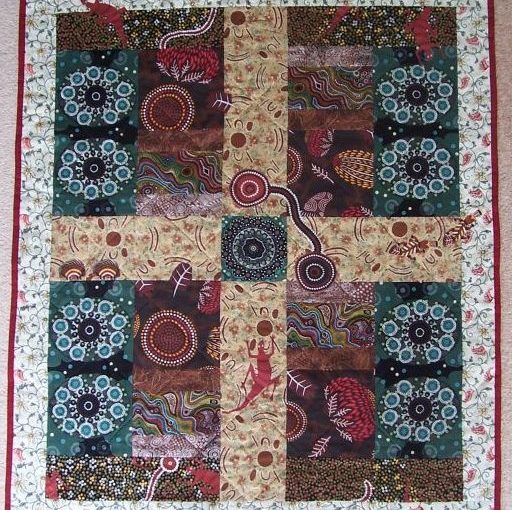
This was made up from the VERY last fabric pieces left over from the Red Dust quilt and the Aboriginal colourwash wall hanging shown above. The backing was made from leftover squares from the backing of a much earlier embroidered native flowers quilt and from the backings of the Red Dust quilt and the Aboriginal wall hanging. The binding was a leftover too, as was the batting. So it cost me nothing at all except my time. The trick was to combine those materials into a decent design, so that it looked as though they were specially chosen. I added some whimsical details, such as a goanna, two tiny exhidnas and two small platypus chasing each other; as well as a pair of dotted circles joined by a wandering path. I also extended two goannas and a couple of fern fronds into their nearby borders. You can see most of those features more clearly in the close-ups. I think all that worked. And at last, I have used up all of those fabrics, Yay! I gave this one to Bec, who uses it as a tablecloth.
Category: Wall hangings
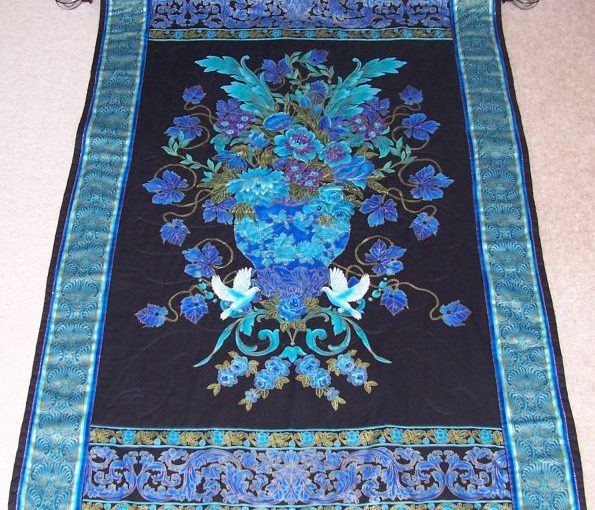
Flowers, doves and urn wall hanging
In early 2015 I bought a a beautiful panel with a depiction of an urn, flowers and doves, These were in mostly bright blue colours, and some green, on black, and I decided to make a wall hanging from that. It wasn’t difficult to construct, because I didn’t need to do any patchwork – just add borders. To include some input of my own, though, I embellished it with sequins and very small beads to highlight certain parts. I also used gold metallic thread to sew on top of, and to emphasise, some gold lines, particularly around the border and the edge of the urn. The other thing I did was to experiment with the quilting. Using my old French curves, I marked out a large stylised flower on the back and quilted right through all layers with invisible thread. If you look closely, you might just see the quilting. I bought the rod from Ikea. It measures 78cm across by 108cm tall (31″X 43″). I gave this one to my cousin, Sue.
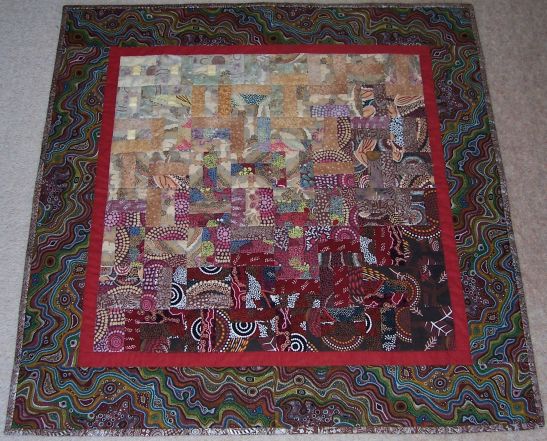
Aboriginal colour wash wall hanging
Using the post and rail technique, I made this with leftover fabrics from the Red dust quilt. I have attached six antique buttons on the squares in the top left hand corner, which is the palest area on the quilt (close-up shown below). These buttons originally belonged to my great grandmother (or so my mother told me). They’re probably ivory, but it’s also possible that they are from the earliest plastic (celluloid) buttons manufactured. However, I don’t think so, because they are not identical – they differ slightly in size and thickness and are obviously hand-carved – and the holes for attaching them aren’t in exactly the same places either. Also, they feel and (when rattled together) sound harder than plastic.
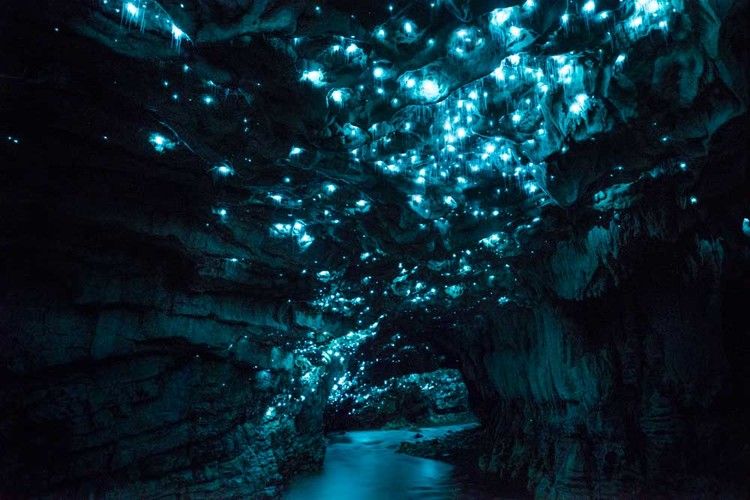
Glow worm wall hanging
From the leftover purple fabric from the Moonglow quilt, I decided to make a colourwash wall hanging, using the post and rail technique. However, nearly all the fabrics were dark purple, with only a few that could be shaded (‘washed’) to light purple, and it seemed best to have all the dark fabrics around the edges and the lighter ones in the middle. I thought it might lack something, though, and be a bit boring without a focus. I don’t know how, but the thought popped into my mind to make it into a depiction of a glow worm cave. Not ever having seen such a cave, I consulted Prof. Google and found images of some New Zealand glow worm caves (photos attached below). Using these to guide my construction, I used all sorts of silver ‘junk’, such as beads and chains, as well as embroidered metallic silver thread strings in various thicknesses, to emulate the glow-worm strings. I also found a remnant of shiny purple polyester fabric, just in the right shade, from my stash to construct the underground stream. I outlined the cave with a (deliberately) ‘messily’ embroidered variegated metallic thread.
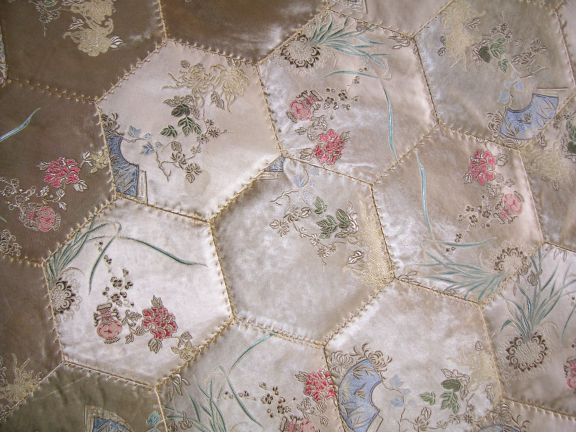
Japanese silk wall hanging
In late 1969, my father, being by then a big shot in BHP, was sent to Japan for a week or so on business. While he was there, he bought some gifts for my mother, my sister and me. These included an embroidered silk dressing gown for each of us. Mum’s was gold, Rhonda’s blue and mine red. Mum used hers a lot, but after Dad died she gave it to me so that I might ‘do something with it’. Unfortunately, over the years, some parts had become soiled, although the lining was still in excellent condition. I used my ScanNCut machine to cut hexagons over the undamaged embroideries, and then joined them. I used the lining to back the quilt and to make the binding. I quilted it in feather stitch with metallic gold thread. There was enough for a small wall hanging, and I feel pleased at honouring both my parents in this way.
Peacock quilt
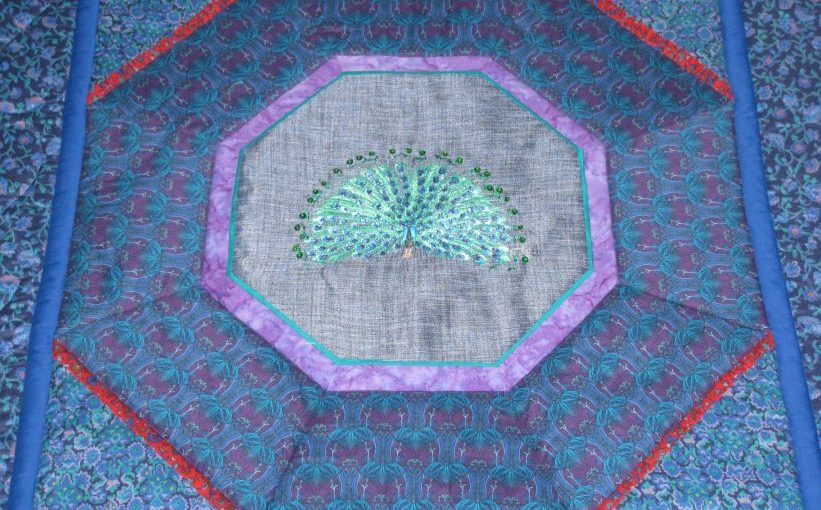
This quilt has a very long story attached to it. A friend of mine, who does voluntary work in an op. shop, noticed that a colleague who was sorting donations was about to throw out a stack of beautiful fabrics, so she asked why, and was told that ‘nobody would want them’. My friend said she knew someone who would like them, whereupon the other lady tossed the bag to her and said, ‘Well, give it to her then!’ So she gave them to me. It was immediately obvious these colour-coordinated fabrics were not only exquisitely beautiful, but were also of very high quality. Upon further investigation (helped by the label on the bag, but I did work it out before noticing that), they turned out to be Liberty fabrics – only the best in the world! So I felt that I should do something very special, and decided to design a wall hanging to showcase them. I had to be very careful, because if I had made a mistake I would never have been able to replace any of them. So I decided to learn a computer-based program for designing quilts to help get it right (because I couldn’t exactly duck down to the local patchwork shop to buy more if I made a mistake). I wanted it to be a medallion quilt, and with that in mind I embroidered a peacock in matching colours on a blue Thai silk fabric I already had in my stash, to form a central octagon. This was embellished with some sequins on the ends of feathers. I bought a few extra fabrics (three, I think) to help with the final design. The bright red trim and binding, serendipitously also a Liberty fabric, was given to me by a friend. This was entirely my own design and I am extremely proud of it, but as it’s so large, I haven’t yet found a place to hang it. I don’t think the photos do it justice.
Teacup wall hanging
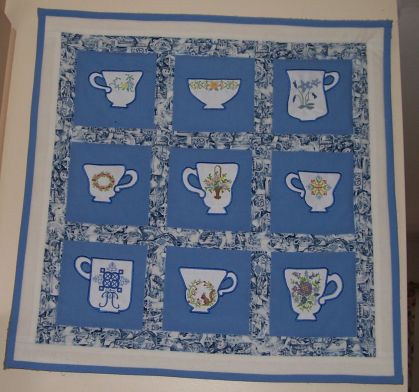
During the same (holiday) period in 1998 I also made a wall hanging of teacups, using my new-found skills on the embroidery machine. I embroidered the cups with various small patterns, and then appliquéd them onto the plain blue fabric using the embroidery machine. The blue and white fabric around the squares features teapots and cups too.
Three mini quilts of plates
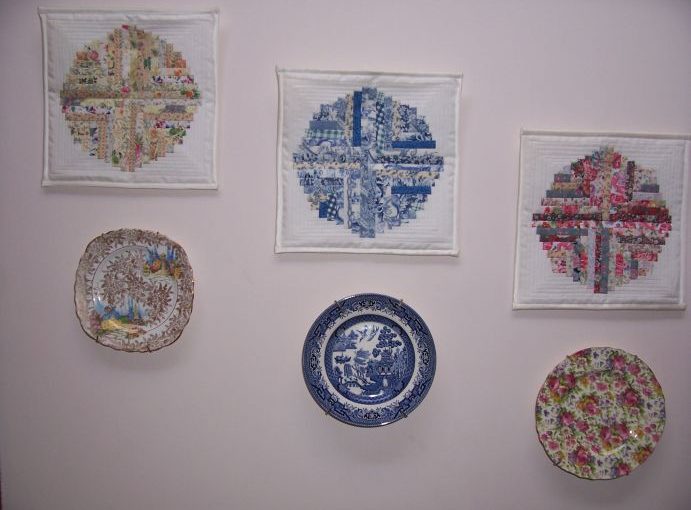
In about 1998 I made three mini quilts in the traditional log cabin technique, each representing a well-known antique plate: a blue one for a Spode Willow pattern; a floral rose coloured one for a ‘Mille fleurs’ plate from the Royal Winton ‘Chelsea’ range; and a yellow and gold one for a Colclough plate, also closely patterned. I used the pattern and instructions from a book on miniature quilts by Deborah Brearly. They were hung on the stairwell wall by themseves for many years. I’d always intended to look for and buy their ‘real life’ counterparts, similarly sized, and finally accomplished that task in early 2016.
Magic forest wall hanging
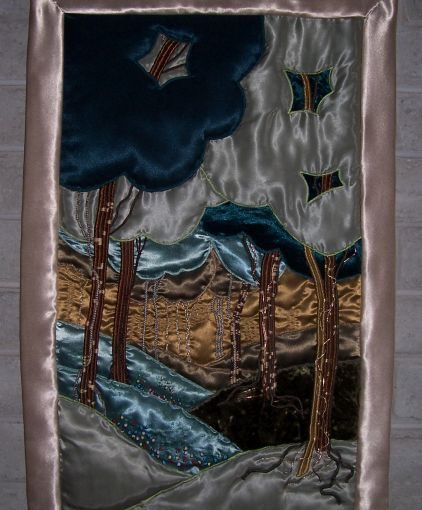
My music teacher said I needed a wall hanging next to my piano to soften the tone from the bass end, because the sound was bouncing off a wood panel wall. I decided to make my own, and found a lovely pattern of a mysterious forest. It was my first attempt at a wall hanging, and it involved a lot of hand sewing and hand embroidery for the flowers. I made some modifications too, and this was the result. I enjoyed making it, even though it took time off my piano practice for a while. When I showed this one to a Thai friend of mine, she commented that it would be a good place to hide all my diamonds and sapphires. !!!!!????? I beg that none of you pull this wall hanging apart in the hope of finding such a treasure!