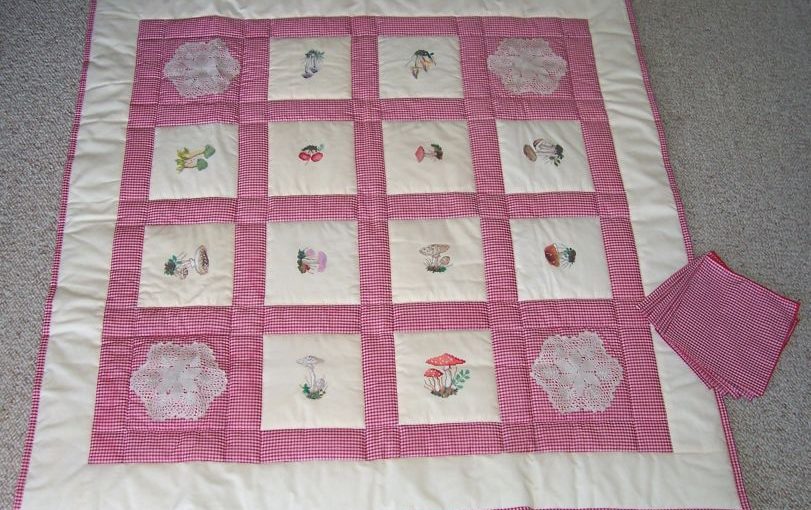
This one should be in a category of its own. For this, I embroidered twelve mushrooms and toadstools in cross stitch on calico squares, and for the remaining corner squares I attached four identical crocheted doilies that had belonged to my grandmother. The inside borders and binding are in red gingham, as befits a picnic mat. There was enough leftover gingham to make six good sized napkins. The mat could also be used as a tablecloth on a picnic table, although it is somewhat ‘puffy’ for this purpose. At last I understood what quilting was about, and did a good job on this one, but I was still stuck on squares. However, that is quite appropriate for a picnic mat.
Author: Glenice Taylor
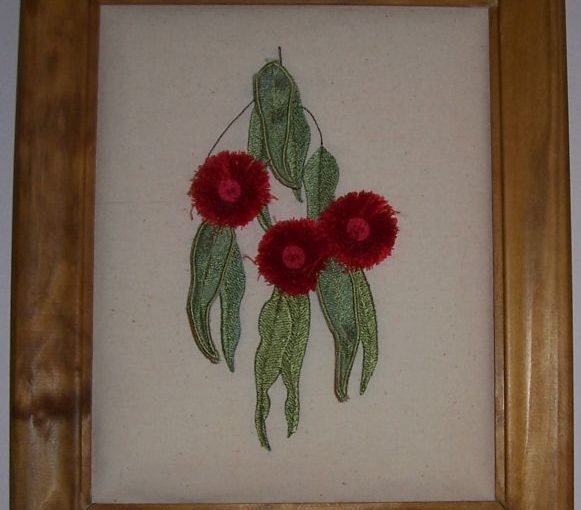
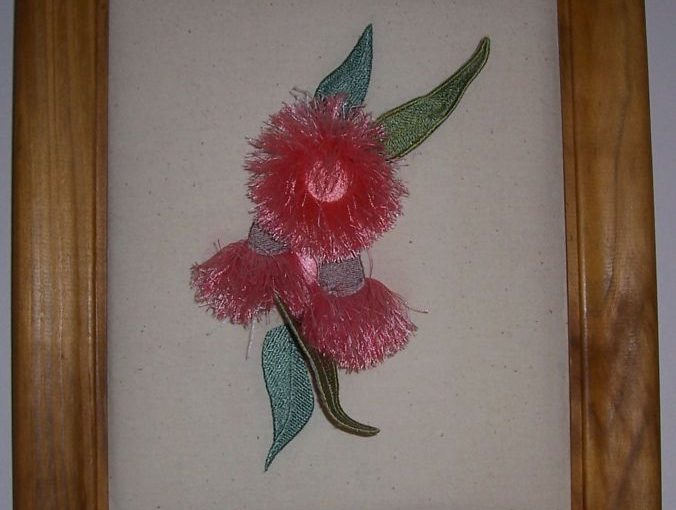
Red Eucalyptus
Pink Eucalyptus
Picnic mat
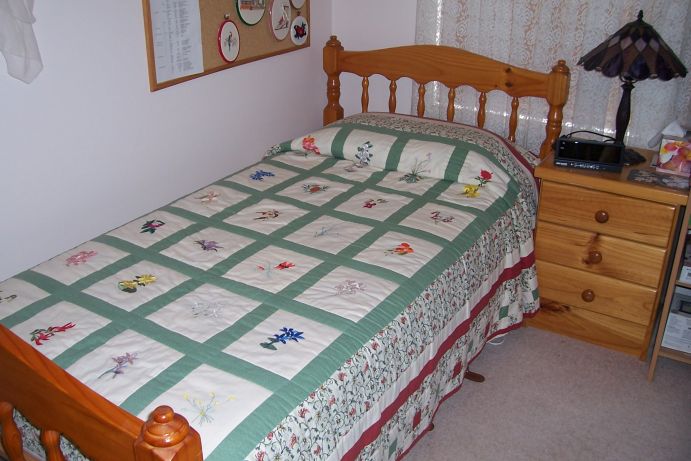
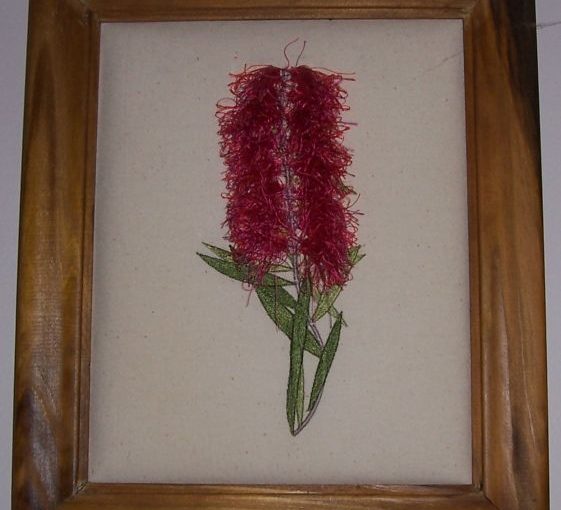
Two quilts of Australian native flowers
The first of these is of cotton and calico, with machine-embroidered flowers on each calico square. The first border also depicts a native flower pattern. This one is in use on a spare bed.
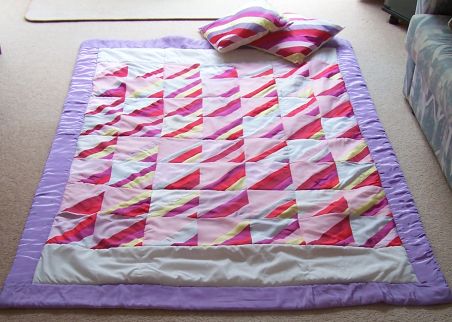
I’m not sure, however, why I made the second one – but possibly because I wanted to showcase all the native flower embroideries I had, as I loved all of them. It is made from shiny polyester fabrics, so it looks pretty, but I guess I’m worried about its durability if put on a bed and used often. By this time, I had acquired the practice of binding – but I still didn’t attach them properly!
Guest quilt for a young child
Again, the construction of this one was very sloppy. In fact, apart from sewing around the inside of the mauve border, there is no quilting whatsoever in the middle. That’s probably just as well, because, like the History quilt, it is very wibbly wobbly, as I noticed to my shame when ironing it for this photo. Any quilting would have introduced lots of tucks. Again, no binding, as I hadn’t yet come across that concept. Also, the fabrics were of cheap polyester – some were from lining fabrics – and there was a lot of cutting on the bias, as I recall. Still, it looks pretty, doesn’t it? The little girls like it, which is all that matters. (Well, no – it does matter. I would do a much better job these days!)
Memory quilt
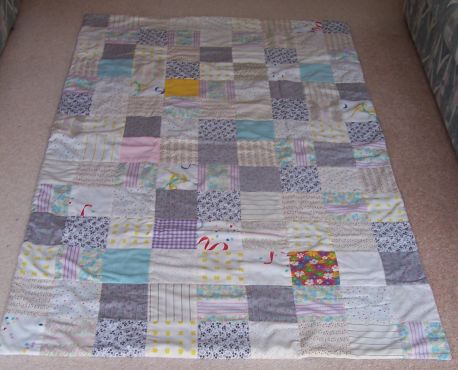
This was the very first quilt I made – back in 1986, I think. I could only barely call this a ‘quilt’, because the quilting consists only of a few lines of sewing down and across, and there’s no binding. I sewed it together with the right sides facing each other, then turned it out and hand-sewed the gap. At least the corners of the patches meet quite well, but as you can see, the quilt is a bit – er – loose. I made it from leftover scraps of fabric from dresses I’d made for my young daughters, from dolls’ dresses I’d made, leftover cotton curtain fabric, and from old camping pillowcases and other materials from the previous ten or so years. So it still holds some nostalgia for me, and I have since learned that these items are called ‘Memory quilts’. I was pleased with the result, and it has been surprisingly hardy, as well as providing extra warmth on top of a bed when needed on a very cold, Canberra night.
Colours of Seville
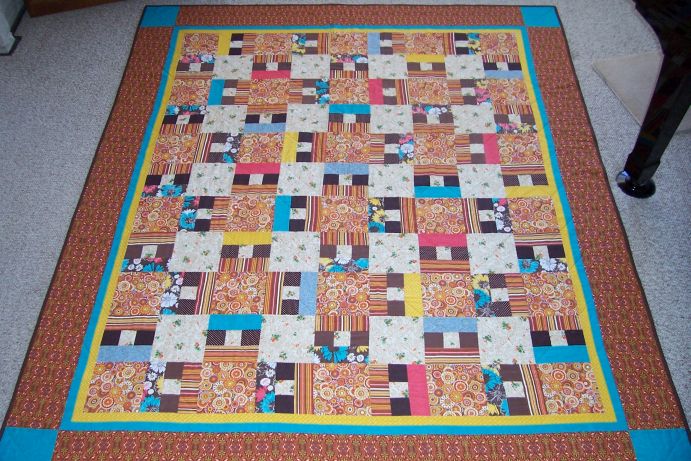
Some years ago I bought some fabrics from a Spotlight bin that attracted me by their bright coordinated colours. I added some old floral fabric (probably from the ’70s) that my mother gave me, as well as a few other fabrics from my stash. I also bought some extra plain and small-patterned matching fabrics and some dark brown for the backing and parts of the top. Two of the Spotlight fabrics had ‘Moor-ish’ (Islamic) motifs, a third one was a coordinated stripe pattern and a fourth had what looked like stylised citrus fruits; hence the name ‘Colours of Seville’, because that region has some Eastern history and is famous for its oranges. There was no place on the top for one of the Spotlight fabrics, so I used that, the remaining striped and light floral fabrics on the back, and the dark brown fabric to create an alternative ‘top’. So the quilt is double-sided. I didn’t quite know what to do with this one, but my sister, Rhonda, really loved the bright colours and the ‘retro’ look, so I gave it to her (in anticipation of her birthday) for her spare room bed. Using my ScanNCut machine, I cut the remaining fabrics into hexagons to make two identical cushion tops. From two large antique linen table napkins I cut squares for the the reverse side. After some sleuthing my sister discovered that the napkins had belonged to our great-great grandmother, Mary, so we were very pleased to honour our ancestor in this way. In a stroke of luck, Rhonda already had matching sheets and pillowcases on that bed.
Blue colourwash quilt and floor mat
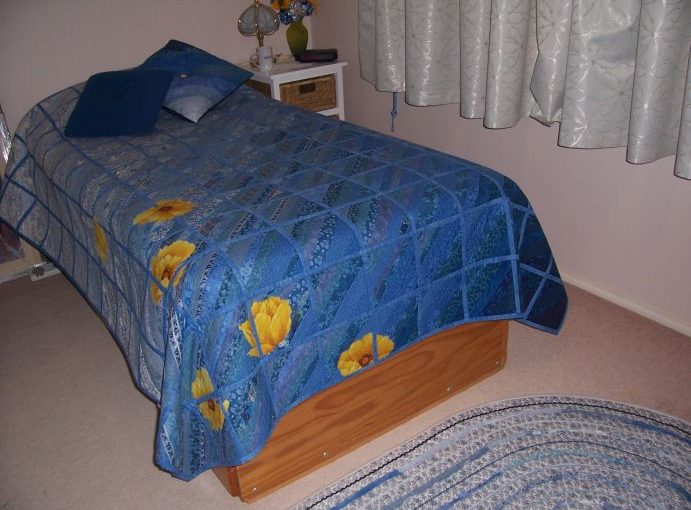
In one of my quilting books I saw a colourwash quilt called ‘Autumn’, designed by Judy Turner . It was in lots of autumn colours (obviously) and looked gorgeous, but I decided it might be easier to do my first colourwash quilt in monochrome, and chose blue. I started with white in the top left corner, finishing with midnight blue in the diagonally opposite corner. In retrospect, I now think that the monochrome option was not easier after all, because any imperfection in the gradations were more obvious and therefore I needed to take great care. Nevertheless, it turned out very well. I added some bright yellow flowers to contrast with, and lift, the blue background, and made the flowers look like they were being blown out by the wind, through the grid, or lattice. With the leftover fabrics, and using a light blue fabric I already had for the underneath, I made the raggy-style floor rug. I had seen something similar in a gift/craft shop and thought I could make one myself. It serves to cover a patch of the carpet that hadn’t faded in concert with the rest of the floor.
Spare room quilts
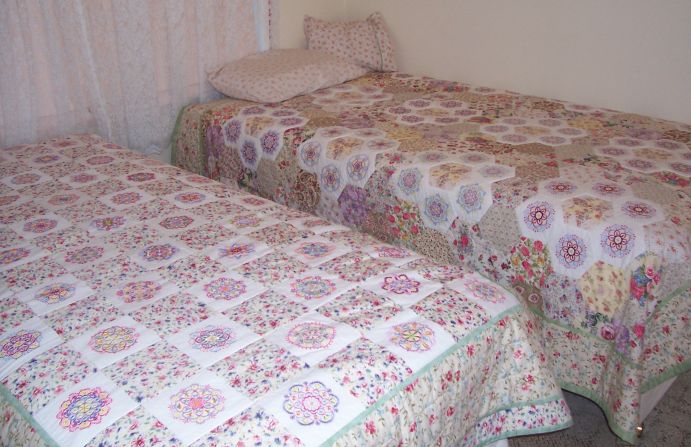
The quilt on the King single bed was made from a pattern called ‘Heavenly Hexagons’, which was designed and digitised by Janet Sansom. I used different fabrics, but apart from that, and adding a couple of borders, I followed the instructions. There was some leftover fabric, and a single-bed trundle that needed a quilt too, so I embroidered more of the digitised designs on quilter’s muslim – squares this time – and cut up some other floral fabric I had into squares too. The floral fabric happened to coordinate beautifully with the patched hexagons and triangles in the first quilt. These two sets of squares were then patched together, and borders in the same fabrics of the first quilt were added. When both beds are out together they make a coordinated pair.